Interior design 10 min read
Laminate vs Veneer vs PU vs Duco: Choosing Finishes for Wardrobes, Kitchens and Furniture
How laminate, wood veneer, PU and duco finishes differ in look, durability, repairability and relative cost, and which suits wardrobes, kitchens, TV units and furniture in Indian homes.


In short
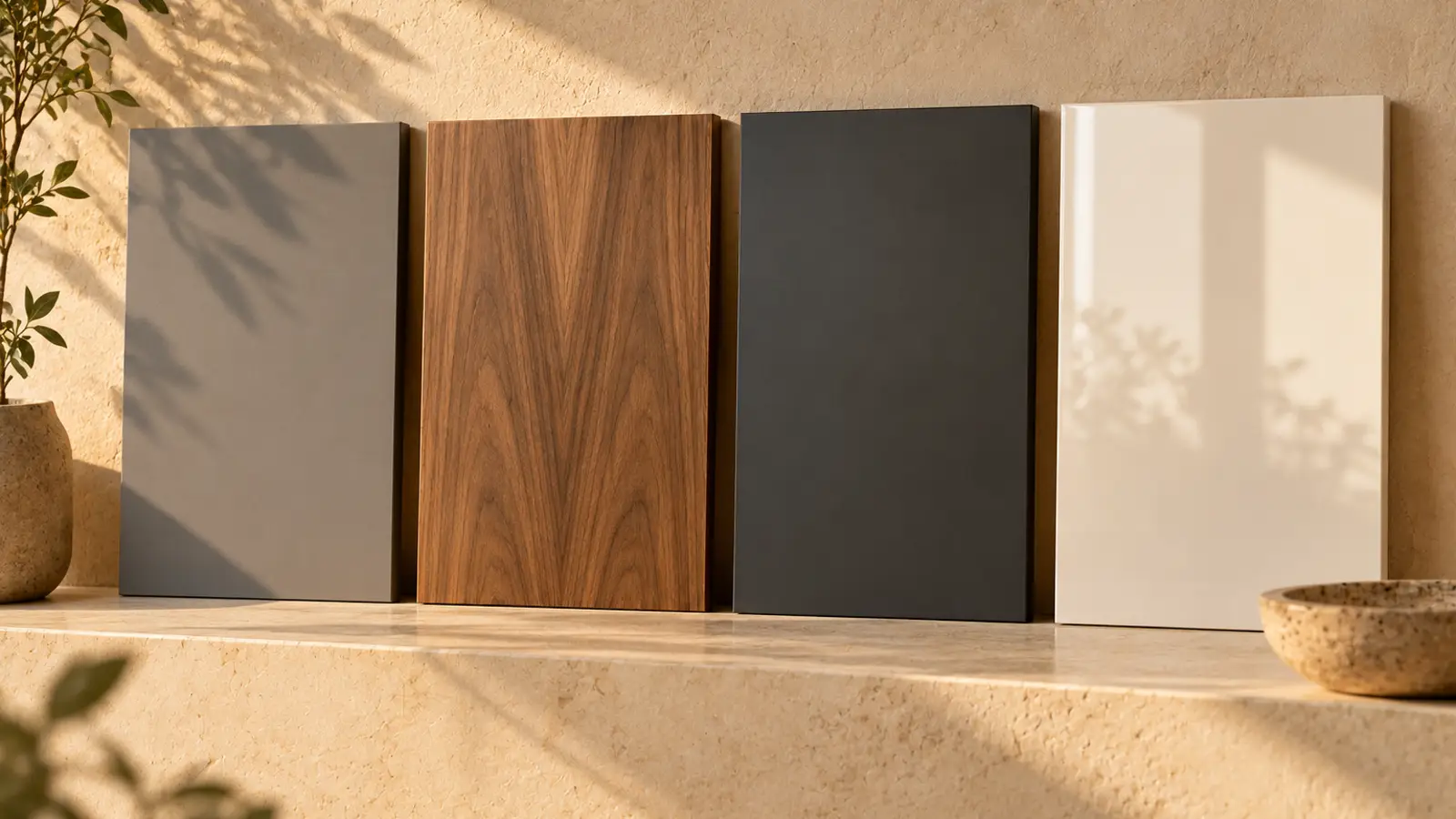
Laminate, veneer, PU and duco are the four finishes most Indian wardrobes, kitchens and furniture units are made in. Laminate is a factory-made decorative sheet: tough, consistent and the most economical, but it cannot be refinished. Veneer is a thin slice of real wood that gives the look of solid timber and must be polished on site or in the workshop. PU is a polyurethane coating, clear over wood or pigmented as a paint, that gives a seamless matte or gloss surface. Duco is the Indian term for a sprayed lacquer paint finish, prized for smooth solid colours. The right choice depends on where the surface is, how much wear it gets, the look you want and your budget.
- Laminate is the most durable everyday surface for the money and suits kitchens, children’s rooms and wardrobe interiors, but it shows dark edge lines and cannot be re-polished.
- Veneer is real wood with natural grain variation; it needs a protective polish (PU is tougher than melamine) and can be lightly refinished later.
- PU and duco give seamless painted or lacquered surfaces with no visible edge bands, in any colour, but cost more and need careful spraying in a dust-free setting.
- Edges and handles are where finishes fail first, so ask how edges are sealed and how much the surface will be touched.
- Specify finishes by product, thickness or number of coats in your quotation, not just by name.
The four finishes at a glance
Most built-in furniture in Indian homes is made from a board, usually plywood or MDF, with a finish on top. The board gives strength (see solid wood vs plywood vs MDF). The finish gives the look, the feel and most of the everyday durability.
| Laminate | Veneer | PU | Duco | |
|---|---|---|---|---|
| What it is | Factory-made decorative resin sheet | Thin slice of real wood | Polyurethane coating, clear or coloured | Sprayed lacquer paint |
| Look | Any colour, print or texture; very consistent | Natural grain, every sheet different | Seamless matte, satin or gloss | Seamless solid colour, often high gloss |
| Edges | Edge band or laminate strip, often a visible line | Edge band or solid wood lipping | Coated around edges, no line | Coated around edges, no line |
| Everyday durability | High | Depends on polish | High | Medium to high |
| Repairable | Hard; usually replaced | Yes, light refinishing | Yes, by re-spraying | Yes, by touch-up or re-spraying |
| Relative cost | Lowest | Medium | High | High |
Laminate
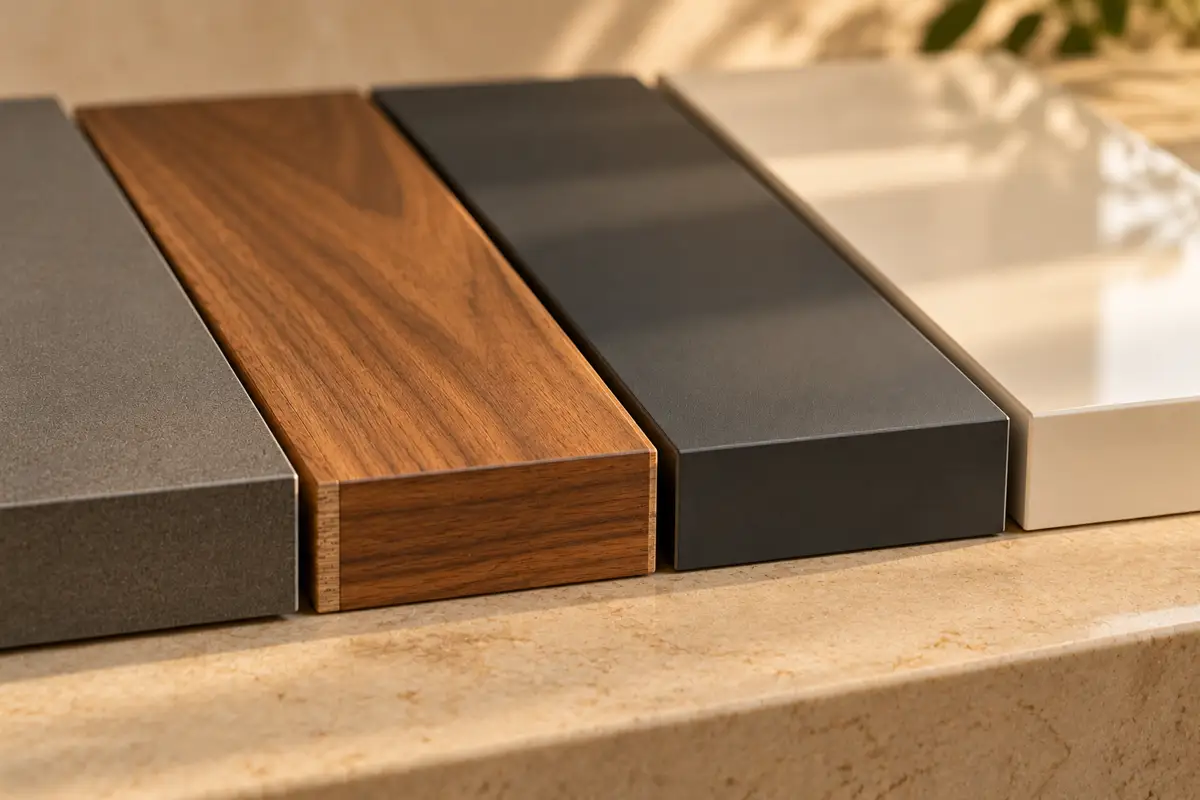
Decorative high-pressure laminate (HPL) is made by pressing layers of resin-soaked kraft paper with a printed decorative paper and a clear protective overlay under heat and high pressure. The Indian Standard for these sheets is IS 2046. The finished sheet is bonded to plywood or MDF with adhesive.
Sheets for exposed surfaces are commonly around 1 mm thick. Thinner liner sheets are used inside wardrobes and on the back face of panels, where they also balance the board so it does not bow.
Good for: kitchens, children's rooms, study tables, wardrobe interiors, offices and anywhere that sees heavy daily use.
Watch for:
- Edges. Most laminates have a dark core, so cut edges show a thin line unless a matching edge band is used. Edges are also where moisture gets in, so they must be sealed properly, especially near sinks.
- Joints in large panels. Sheets come in standard sizes, so very tall or wide surfaces may need a joint.
- No refinishing. A deep scratch or a burn cannot be sanded out.
Variations you will hear about include acrylic sheets (very high gloss), anti-fingerprint matte laminates, and compact laminate, a thick solid laminate used for washroom partitions and some countertops.
Veneer
Veneer is a thin slice of real timber, typically well under a millimetre, peeled or sliced from a log and glued onto a board. It lets you use beautiful and expensive species such as teak, walnut or oak across large surfaces at a fraction of the cost of solid wood, with a far more stable core. Decorative veneered plywood is covered by the Indian Standard IS 1328.
Because veneer is natural, no two sheets are identical. Good workshops lay out veneer leaves so the grain flows across a wardrobe's shutters, a technique called book-matching or slip-matching. Ask to see the actual leaves before they are used.
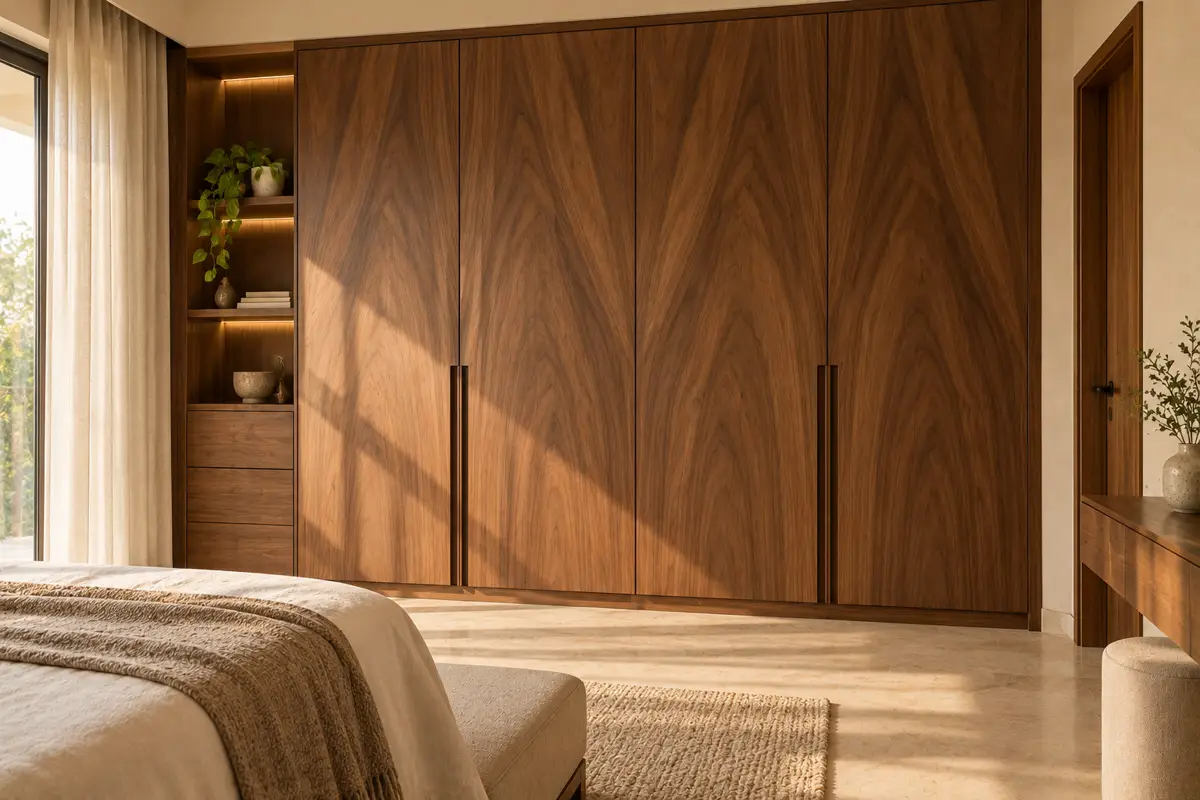
Veneer is raw wood on arrival and must be polished to protect it:
- Melamine polish is economical and gives a natural look, but is less resistant to water, heat and scratches.
- PU polish (clear polyurethane) is harder and more water-resistant, and the usual choice for surfaces that are touched often, such as table tops and shutters.
Good for: living rooms, bedroom wardrobes, wall panelling, TV units, doors, and anywhere you want the warmth of wood.
Watch for: colour variation between batches, darkening or yellowing over time in direct sunlight (natural for wood), and water marks if the polish is thin. Because the veneer itself is thin, it can only be sanded lightly when it is refinished.
PU finish
PU (polyurethane) is a sprayed coating that cures into a tough, flexible film. It comes in two forms:
- Clear PU goes over veneer or solid wood to protect it while showing the grain.
- Pigmented PU, or PU paint, is an opaque colour applied over a smooth board, usually MDF, after careful sanding and priming.
PU paint gives a seamless surface with no edge lines in any colour, from deep matte to mirror gloss, with good resistance to moisture and household chemicals. That makes it popular for modern wardrobes, handle-less kitchens and statement furniture.
Watch for: it is labour-intensive, needs several coats with sanding in between, and must be sprayed in a clean, dust-free setting for a flawless finish. Gloss shows every fingerprint and every flaw in the board beneath it. Damage can be repaired, but matching a gloss colour exactly takes skill.
Duco finish
In India, duco usually means a sprayed lacquer paint finish. The name comes from a historic automotive lacquer brand and stuck as a general term. Like PU paint, it gives a smooth, solid-colour surface with no visible edge bands, and it is applied in layers of primer, colour and top coat, sanded between coats.
Lacquers dry fast and are relatively easy to touch up locally, which makes repairs simpler. They are generally less hard than PU against scratches, solvents and moisture. Many workshops today use a PU top coat over a lacquer or PU base and still call the result "duco", so the names alone do not tell you what is being applied.
Good for: feature furniture, bedroom wardrobes, consoles and display units, where a refined painted look matters more than kitchen-level abuse.
Which finish where
| Location | Good choices | Why |
|---|---|---|
| Kitchen shutters near sink and hob | Laminate, acrylic or PU | Moisture, heat and cleaning every day |
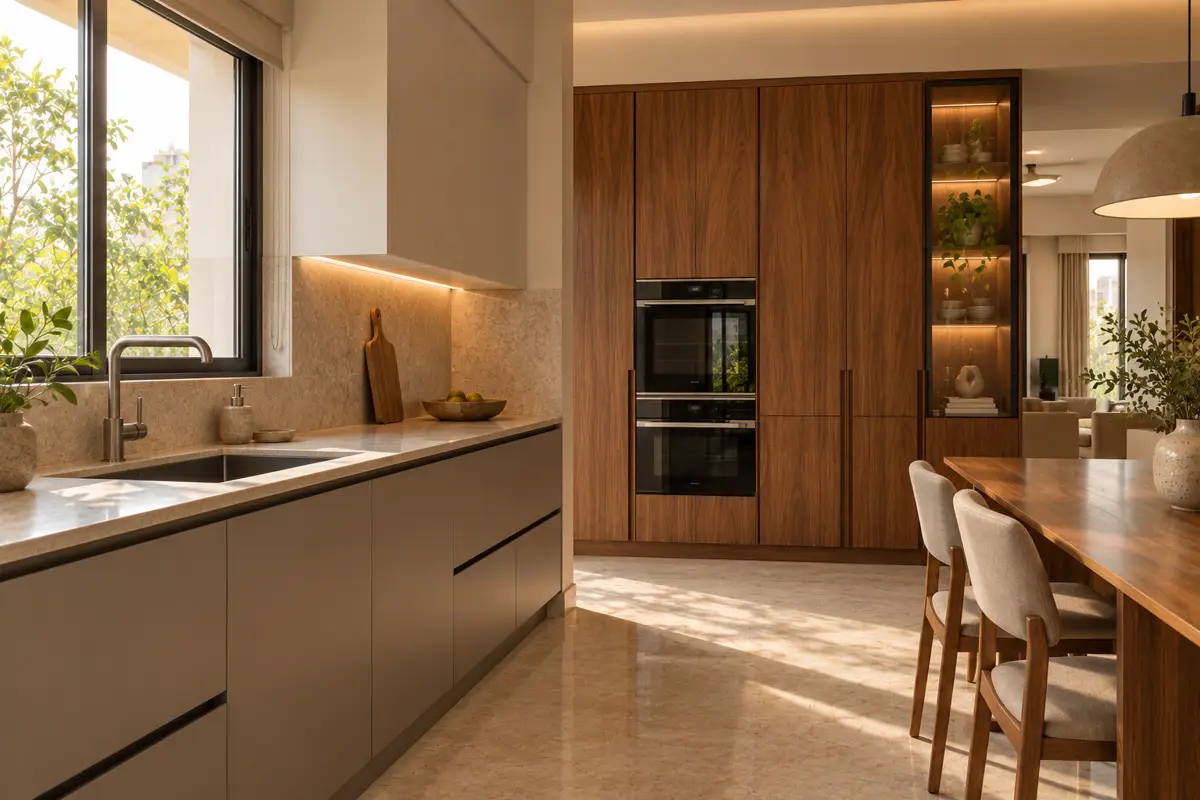
| Kitchen tall units, open-kitchen side | Veneer with PU polish, or PU paint | Seen from the living area, less wear |
| Bedroom wardrobe shutters | Veneer, PU or duco | Mostly about the look; moderate touch |
| Wardrobe interiors | Laminate liner | Easy to clean, keeps cost sensible |
| Children's rooms | Laminate | Survives knocks, crayons and cleaning |
| TV units and wall panelling | Veneer or PU | Large, visible surfaces with little wear |
| Dining and coffee table tops | Solid wood or veneer with PU | Must resist water rings and heat |
| Office workstations | Laminate | Heavy daily use |
Mixing finishes is normal and often the best answer: veneer or PU where you look, laminate where you work.
How to specify finishes in a quote
Finish names are used loosely, which is why the same "PU wardrobe" can be quoted at very different prices. In your bill of quantities, ask for:
- Laminate: brand, range, shade code, thickness, and the inside liner.
- Veneer: species, whether natural or reconstituted, and the type of polish.
- PU or duco: the board underneath, the coating system and the finish level (matte, satin or gloss).
- Edges: edge band thickness and colour, or how painted edges are sealed.
- Samples: a finished sample panel approved by you before production.
If you are planning a whole home, our guide to what a turnkey interior project includes explains where these choices fit in the overall process.
How we choose at Savistar
At Savistar, material and finish selection is a stage of every interior project: we help you choose materials, colours and finishes, matching each surface to how it will be used rather than finishing a whole home in one material. For pieces that deserve real timber, our furniture brand SAAG makes bespoke solid-wood furniture in-house. See how this comes together in our interiors portfolio, or book a free consultation to talk through the finishes for your home.
Frequently asked questions
Which is better for a wardrobe, laminate or veneer?
Laminate is better if you want a tough, low-maintenance surface at a lower cost, and it is the usual choice for wardrobe interiors. Veneer is better if you want the warmth and grain of real wood on the outside of the shutters. Many wardrobes combine the two: veneer or PU outside, laminate inside.
What is the difference between PU and duco finish?
Both are sprayed coatings that give a smooth, seamless surface. In India, duco usually refers to a lacquer paint finish, the term borrowed from a historic automotive lacquer brand. PU is a polyurethane coating that can be clear, to protect wood or veneer, or pigmented, as a paint. PU is generally harder and more resistant to scratches, moisture and chemicals, while lacquer finishes are easier to repair locally. In practice the names are often used loosely, so ask your designer which coating system is being used.
Is laminate good for kitchen cabinets?
Yes. Laminate is one of the most practical kitchen finishes because it resists stains, moisture and everyday knocks, and it is easy to clean. The cabinet core underneath still matters: in wet zones such as the sink unit, use a water-resistant board and seal all edges well.
Can veneer be used in kitchens?
It can, but it needs a tough polish such as PU and more care around the sink and hob, where water and heat are constant. Many people use veneer on tall units or the dining side of an open kitchen, and laminate, acrylic or PU on the working areas.
Which finish lasts the longest?
For daily wear without maintenance, a good high-pressure laminate is the hardest to damage. For longevity over decades, veneer and PU have an advantage: they can be repaired or refinished, while a damaged laminate sheet usually has to be replaced.
Which finish is the most expensive?
As a general order, laminate is the most economical, veneer with polish costs more, and PU paint or duco is usually the most expensive because of the surface preparation, multiple coats and spraying involved. Exact prices depend on the brand, thickness, colour and number of coats.
About the authors
Sachi and Haripriya founded Savistar in Gandhinagar in 2020 after training at CEPT University, Ahmedabad. They run the interior design studio and its furniture brand SAAG, and have delivered 500+ interior and furniture projects across India and abroad. More about the studio
More from the journal
All articles → Interior designTraditional Gujarati Materials and Crafts in Modern Homes: Limewash, Stone, Lippan, Jaali and Textiles5 min read
 Interior designGujarat’s Wood Carving Tradition: Carved Houses of Ahmedabad’s Pols and How to Use Carving Today5 min read
 Interior designRenovating While Living at Home: How to Phase Interior Work With Less Dust, Noise and Stress5 min read