Interior design 6 min read
Kitchen Countertops: Granite vs Quartz vs Marble (and Other Options) for Indian Kitchens
How granite, engineered quartz, marble, Kota stone, solid surface and sintered stone compare on heat, stains, scratches, maintenance and cost, and which countertop suits everyday Indian cooking.


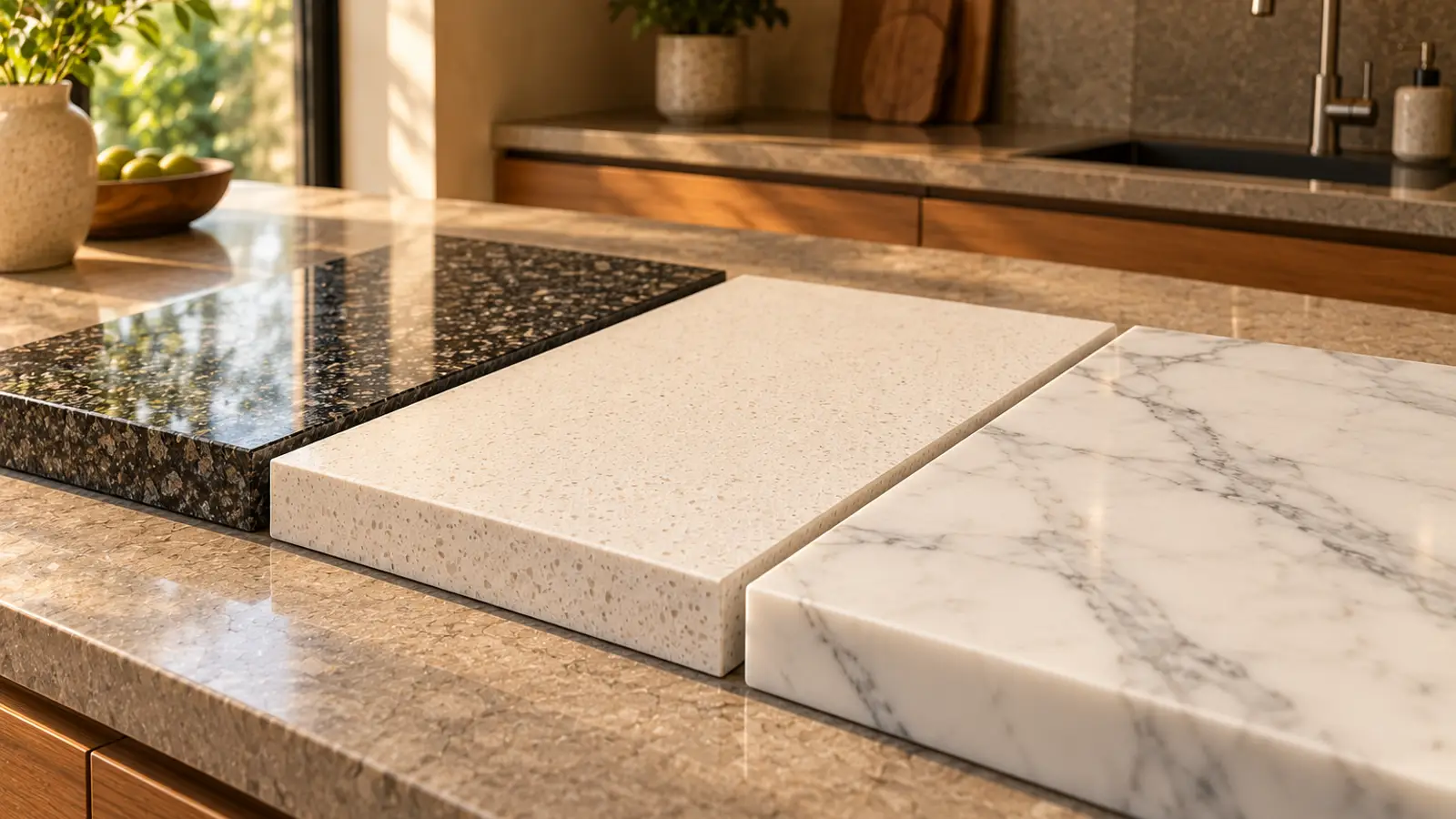
In short
For most Indian kitchens, granite remains the most forgiving countertop: hard, heat tolerant and economical, as long as it is sealed. Engineered quartz looks uniform and resists stains because it is non-porous, but its resin binder can scorch under very hot vessels, so trivets are a must. Marble is beautiful but soft and reacts with acids such as lemon, tamarind and tomato, so it etches and stains in a cooking kitchen. Sintered stone and large ceramic slabs are very hard and heat resistant but need skilled fabrication. Choose by how you cook, not only by how the slab looks.
- Granite is hard, heat tolerant and good value; seal it periodically, especially lighter colours.
- Quartz is non-porous and uniform, but do not put hot kadais or tawas directly on it.
- Marble etches with acids and stains with turmeric and oil; better for a dry counter or table than a working kitchen.
- Sintered stone and porcelain slabs resist heat and scratches but are brittle at edges and need specialist fabrication.
- Edge profile, thickness, joints and sink cut-outs affect durability as much as the material.
How we cook should decide the counter
Indian kitchens are hard on surfaces. Turmeric, oil, tamarind and lemon stain or etch; heavy steel and cast-iron vessels knock and scratch; and a kadai or pressure cooker comes off the flame very hot. A countertop that looks perfect in a showroom can look tired in a year if it does not suit how the kitchen is used.
The options at a glance
| Granite | Quartz (engineered) | Marble | Sintered stone / porcelain | Solid surface (acrylic) | Kota / natural limestone | |
|---|---|---|---|---|---|---|
| Heat | Very good | Fair (resin can scorch) | Good | Excellent | Poor | Good |
| Stains | Good when sealed | Excellent | Poor | Excellent | Good | Poor |
| Acids (lemon, tamarind) | Good | Good | Poor (etches) | Excellent | Good | Poor |
| Scratches | Very good | Very good | Fair | Excellent | Fair (repairable) | Fair |
| Seams | Visible | Less visible | Visible | Visible | Invisible | Visible |
| Relative cost | Low to medium | Medium to high | Medium to high | High | Medium to high | Low |
Granite
Granite is a natural igneous stone made largely of quartz and feldspar. It is hard, takes heat well and is widely quarried in India, which keeps prices reasonable and choice wide, from deep blacks to browns and greys.
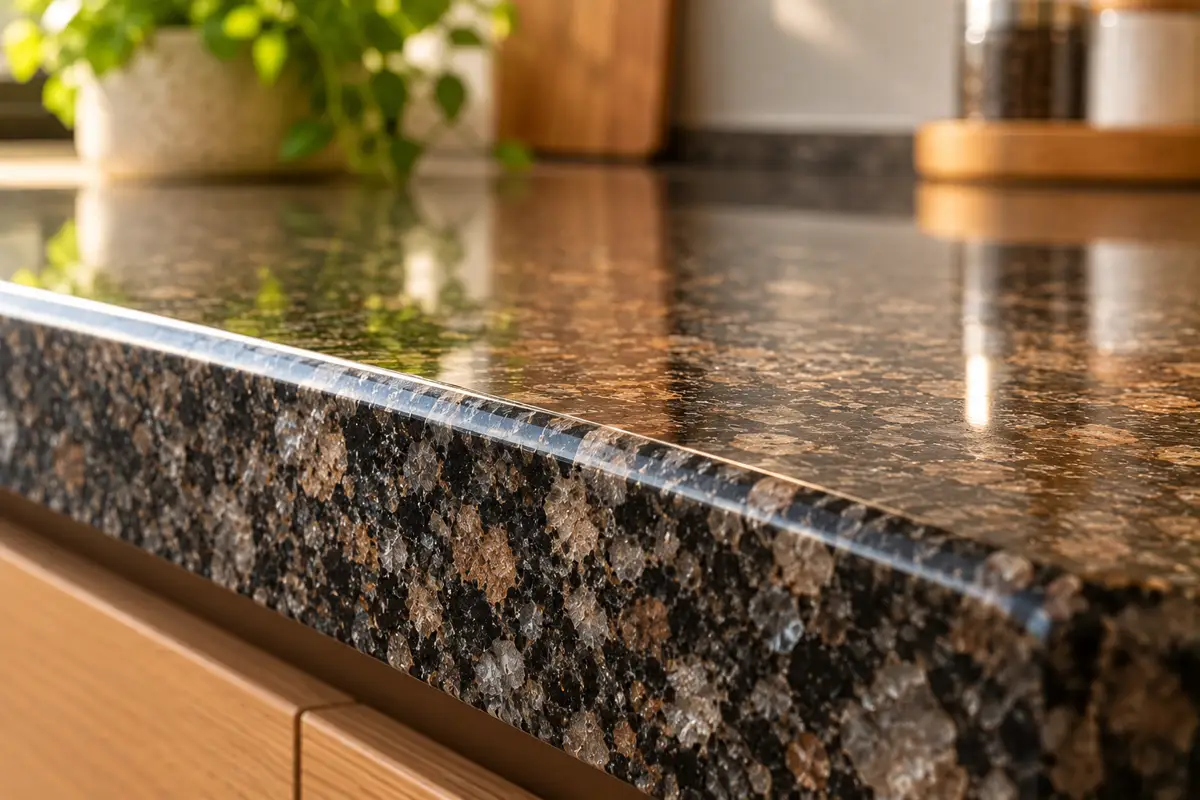
Good for: the main cooking platform in a hard-working kitchen.
Watch for: some lighter granites are more porous and will absorb oil unless sealed. Dark granites show water marks and fingerprints. Joints between slabs are visible, so plan where they fall (away from the hob and sink).
Engineered quartz
Quartz countertops are made from crushed quartz bound with resin and pigments, pressed into slabs. The result is non-porous and very consistent in colour.
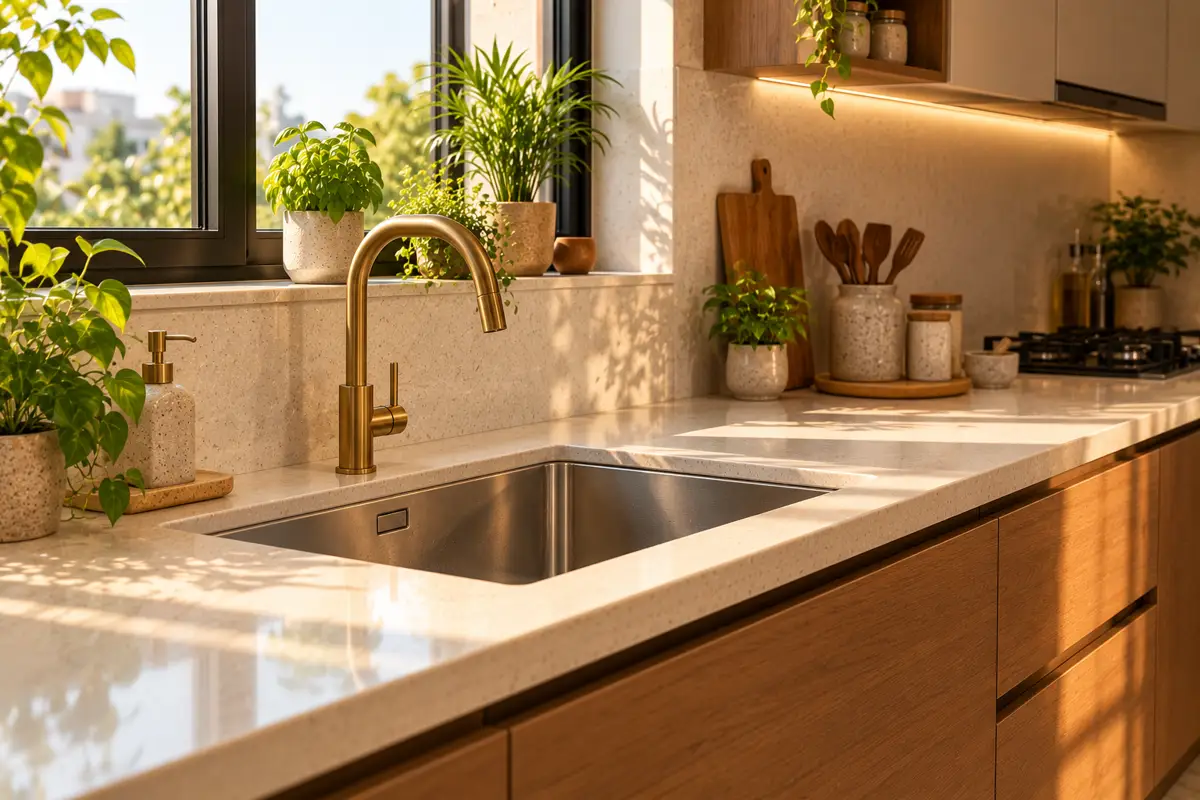
Good for: a clean, uniform look, light colours, and easy maintenance with no sealing.
Watch for: heat. The resin binder can scorch, discolour or crack under concentrated heat, so always use trivets. Some quartz is also less UV-stable, which matters on counters in strong direct sunlight. During fabrication, cutting quartz releases fine silica dust, so it should be cut wet by a fabricator with proper protection.
Marble
Marble, including India's famous Makrana marble, is a metamorphic stone made mostly of calcite. It is cool, luminous and timeless.
Watch for: it etches on contact with acids, leaving dull marks, and it is porous enough to absorb turmeric and oil. It also scratches more easily than granite. In a working Indian kitchen it will patina quickly. Many people love it on a dining table, a bar counter or a dry baking zone, where its ageing is part of its charm.
Sintered stone and porcelain slabs
These are made from minerals fused at very high temperatures into dense, thin slabs. They are extremely resistant to heat, stains, scratches and UV.
Watch for: they are brittle at edges and corners, need specialised cutting, and chips are hard to repair. Choose an experienced fabricator.
Solid surface
Acrylic solid surface can be joined almost invisibly and moulded into integrated sinks. Scratches can be sanded out, but it is not heat resistant and needs trivets at all times.
Kota and other limestones
Kota stone is economical and traditional in Indian homes (see traditional Gujarati materials in modern homes). It is durable for floors but, like marble, sensitive to acids and oil stains as a kitchen counter.
Details that make a counter last
- Edge profile: a slightly eased or bevelled edge chips less than a sharp square one.
- Thickness and support: 18–20 mm slabs need full support on the cabinets; islands with overhangs need thicker slabs or brackets.
- Joint placement: keep joints away from the hob and sink, and have them colour-matched and sealed.
- Sink cut-out: undermount sinks need polished cut-out edges; over-mount sinks hide the edge.
- Backsplash: a stone or tiled backsplash protects the wall behind the cooking zone.
- Hob cut-out: follow the hob manufacturer's dimensions and clearances.
Where countertops fit in the kitchen plan
The counter sits on top of decisions about layout, carcass and finishes. See our guides to modular kitchen layouts, plywood grades for kitchens and shutter finishes.
Choosing with Savistar
Material selection is a stage of every Savistar interior project. We help you choose surfaces by how you cook and live, then specify and coordinate their fabrication and installation. Talk to us about your kitchen.
Frequently asked questions
Is granite or quartz better for an Indian kitchen?
Both work. Granite handles heat better and is usually more economical, which suits heavy daily cooking. Quartz is non-porous, so it resists stains such as turmeric and oil without sealing, and has a more uniform look, but its resin can be damaged by very hot vessels. Many households choose granite for the cooking zone and quartz elsewhere.
Can I put a hot pan on a quartz countertop?
It is best not to. Engineered quartz contains a resin binder that can discolour or crack under sudden, concentrated heat. Use a trivet or a stand for hot kadais, pressure cookers and tawas.
Why is marble not recommended for kitchen counters?
Marble is mostly calcium carbonate, which reacts with acids. Lemon, vinegar, tamarind, tomato and many cleaners leave dull etch marks, and the stone is porous enough to absorb turmeric and oil. It also scratches more easily than granite or quartz.
How thick should a kitchen countertop be?
Natural stone slabs are commonly 18 to 20 mm thick, often with a built-up front edge to look thicker. Thicker slabs, around 30 mm, are stiffer and suit islands with overhangs. Sintered stone slabs are often thinner and rely on careful support.
Does granite need sealing?
Most granites benefit from a penetrating sealer, which reduces absorption of oil and coloured liquids. Dense dark granites absorb very little; lighter, more porous ones need resealing more often. A simple test is to leave a few drops of water on the surface: if it darkens quickly, it is time to seal.
About the authors
Sachi and Haripriya founded Savistar in Gandhinagar in 2020 after training at CEPT University, Ahmedabad. They run the interior design studio and its furniture brand SAAG, and have delivered 500+ interior and furniture projects across India and abroad. More about the studio
More from the journal
All articles → Interior designTraditional Gujarati Materials and Crafts in Modern Homes: Limewash, Stone, Lippan, Jaali and Textiles5 min read
 Interior designGujarat’s Wood Carving Tradition: Carved Houses of Ahmedabad’s Pols and How to Use Carving Today5 min read
 Interior designRenovating While Living at Home: How to Phase Interior Work With Less Dust, Noise and Stress5 min read